
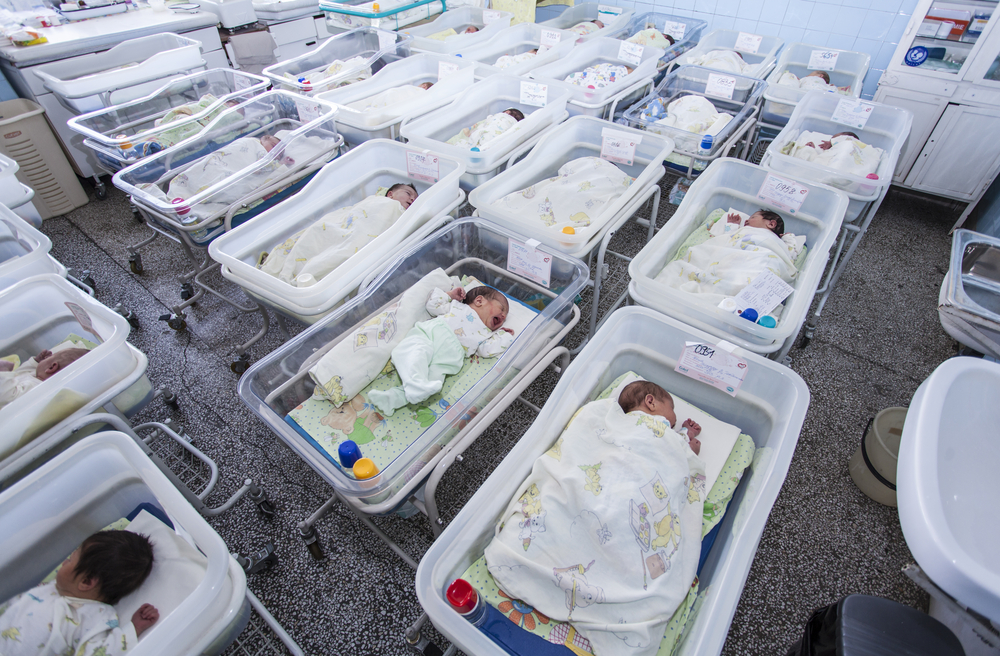
Whether you’re a healthcare professional, expectant parent, or curious reader, these data points offer a snapshot of what childbirth looks like around the globe today. Dive in to see how birth is changing and how innovation is helping to make it safer for families everywhere.
What Are the Latest Global Birth Statistics?
Global birth and fertility trends are shifting fast, with changing family sizes, older moms, and record-low birth rates in much of the world.
- In 2023, the global birth rate was about 16 births per 1,000 population.
- The U.S. had its lowest-ever birth rate in 2023 at 10.7 per 1,000.
- World average fertility is now 2.3 children per woman.
- The U.S. total fertility rate is 1.6 children per woman (below replacement).
- The global number of births is now about 132 million per year (2025), down from 143 million in 1990.
- Globally, the adolescent (age 15–19) birth rate is 41.3 per 1,000 girls (2023), down from 64.5 in 2000.
- The U.S. average age for first-time mothers is 27.5 years (2023). Developed nations have first-birth ages around 28–31, while in high-fertility countries, it’s often in the late teens.
- Women over age 35 account for 12.5% of first births (2023) in the U.S.
- Japan and South Korea both have a mean age at first birth above 31 years.
What’s Changing in Labor and Delivery?
How babies are born is evolving with medical innovation, rising C-section rates, and disparities in access to skilled care. The delivery room today looks far different than it did a generation ago.
- Worldwide, 21% of all births are C-sections, up from 12% in 2000, projected to rise to 29% by 2030.
- The U.S. C-section rate was 32.4% in 2023, totaling over 1.1 million procedures.
- Brazil’s C-section rate is 56.4%.
- Just 19.3% of births in Sweden are C-section deliveries (2023).
- Over 70% of Egyptian births are by C-section.
- Globally, 87% of births are attended by skilled health personnel (2024).
- In sub-Saharan Africa, only 64-70% of births are attended by such personnel, though this varies significantly by country.
- In Sweden and Denmark, more than 99% of births are attended by medical staff.
- In the U.S., vaginal deliveries after a previous C-section (VBAC) were 15.1% of live births.
- Worldwide, nearly 30 million babies are born via C-section every year.
- Median active labor for first-time mothers is about 4-8 hours, but can be 20 hours or more.
What Do the Numbers Say About Epidurals and Birth Pain Management?
Pain relief during childbirth is more sophisticated than ever, but successful epidurals aren’t always easy, and outcomes can still vary by country, technology, and patient needs. Here’s what the latest research tells us.
- 71% of pregnant U.S. women receive epidural or spinal anesthesia (as of 2014).
- Epidural first-pass success in the thoracic region rises from 35% to 69% with real-time ultrasound.
- Obesity about doubles the risk of difficult or failed epidural placement.
- Obese patients are 2.2 times more likely to require multiple epidural attempts.
- Up to 21% of obstetric epidurals can fail and require conversion to general anesthesia for C-section.
- Pre-procedure ultrasound increases neuraxial first-pass success and reduces failed attempts.
- First-pass epidural success in severely obese patients improves from 10% to 42.5% with ultrasound.
- Median skin-to-epidural depth is 4–5 cm in adults.
- Post-dural puncture (spinal tap) headache occurs in 1–2% of obstetric epidurals.
- Blood patch may cure up to 90% of spinal headache cases after one treatment.
- Global epidural use varies significantly across different countries and regions.
- Maternal complications (severe morbidity) are reduced by 35% in epidural users (Scottish study).
- Permanent serious injury from an obstetric epidural is extremely rare (~1 in 50,000).
- 46-90 procedures are generally required for anesthesiology residents to achieve epidural proficiency.
- Modern ultrasound and pressure-sensing technologies further improve epidural safety and outcomes.
- 12% of epidurals fail to provide adequate relief during childbirth.
- 15.2% failure rate for labor epidurals observed in a large prospective study.
- 8-23% of patients experience inadequate pain relief from their epidural.
- 13% of epidural catheters are replaced during obstetric procedures.
- 6.8% of women need their epidural catheter replaced in labor.
What Are the Biggest Risks for Mothers and Newborns Today?
Despite advances in care, childbirth still carries real risks, especially in parts of the world where resources are limited.
- 260,000 women died globally from pregnancy-related causes in 2023.
- U.S. maternal mortality rate was 18.6 per 100,000 live births in 2023 (down from 32.9 in 2021).
- Maternal mortality is more than 3x higher among Black women in the U.S. than white women.
- 87% of maternal deaths worldwide occur in sub-Saharan Africa and Southern Asia (2023).
- Every day, over 700 women die globally from preventable pregnancy complications.
- 1 in 10 infants is born premature globally (about 13.4 million per year).
- The U.S. preterm birth rate was 10.4% (370,000 babies) in 2.
- Black women in the U.S. have a preterm birth rate about 1.4 times above the national average, though this varies from year to year.
- In high-income countries, 9 in 10 preterm babies survive without major health issues; only 1 in 10 do in low-income regions.
- There were 1.9 million stillbirths worldwide in 2023 (one every 17 seconds).
- The U.S. stillbirth rate is 5.4 per 1,000 births (2024).
- Over 98% of stillbirths occur in low- and middle-income countries.
- In the U.S., the risk of stillbirth is 1 in 175 pregnancies.

How Common Are Twin Births?
Twin and triplet births capture imaginations and sometimes surprise expectant parents. These figures reveal where and how often multiples are born.
- The global twin birth rate is 12 per 1,000 births.
- The U.S. twin birth rate is 30.7 per 1,000 live births.
- Nigeria leads the world with over 40 twin births per 1,000 babies.
- 110,393 twins were born in the U.S. in 2023 (3.1% of all births).
- The U.S. triplet and higher order birth rate was 73.8 per 100,000 in 2023.
- Worldwide, 1.6 million twins are born annually.
What Birthing Complications Are Mothers Facing?
Emergency situations like severe bleeding or birth trauma are a constant concern in maternity care. The latest data sheds light on how common these problems are.
- 80-86% of accidental dural puncture cases develop PDPH.
- Pre-procedural ultrasound cuts the risk of failed epidural or spinal anesthesia attempts by up to 79%, helping ensure safe, first-pass success and lowering the cost and pain associated with repeat procedures and complications.
- 5.2% of women developed PDPH that was only identified during hospital readmission, often requiring additional days and costly treatments like blood patch or repeat interventions.
- Chronic headache can persist in 28% of women who experience PDPH.
- Postpartum hemorrhage (PPH) affects 1–10% of deliveries globally, 14 million women a year.
- PPH causes about 27% of maternal deaths worldwide (around 70,000 deaths annually).
- In the U.S., PPH rates rose from 5,634 to 10,504 per 100,000 deliveries (2005–2022).
- Maternal age 35+, multiple births, and C-section increase risk for PPH.
- Hemorrhage is the leading cause of maternal mortality in low-resource settings.
- 4-11% of U.S. vaginal births involve severe perineal tearing.
- Average blood loss is 500 mL for vaginal and 1,000 mL for C-section deliveries.