
In labor and delivery, every procedure brings unexpected variables — even for those who’ve spent their careers on the obstetrics floor. Unpredictability defines work in these units: a place where Dr. Hilary Gallin has spent years mastering anesthesiology’s most demanding specialty. As an obstetric anesthesiologist with an MBA, she understands both the clinical complexities and operational pressures that define modern labor and delivery units.
“What’s uniquely challenging about obstetric anesthesia and being on the labor and delivery floor is that you’re taking care of two patients,” explains Dr. Gallin, M.D., MBA. “You’re taking care of the mom, you’re taking care of the baby, and anything can happen at any moment.”
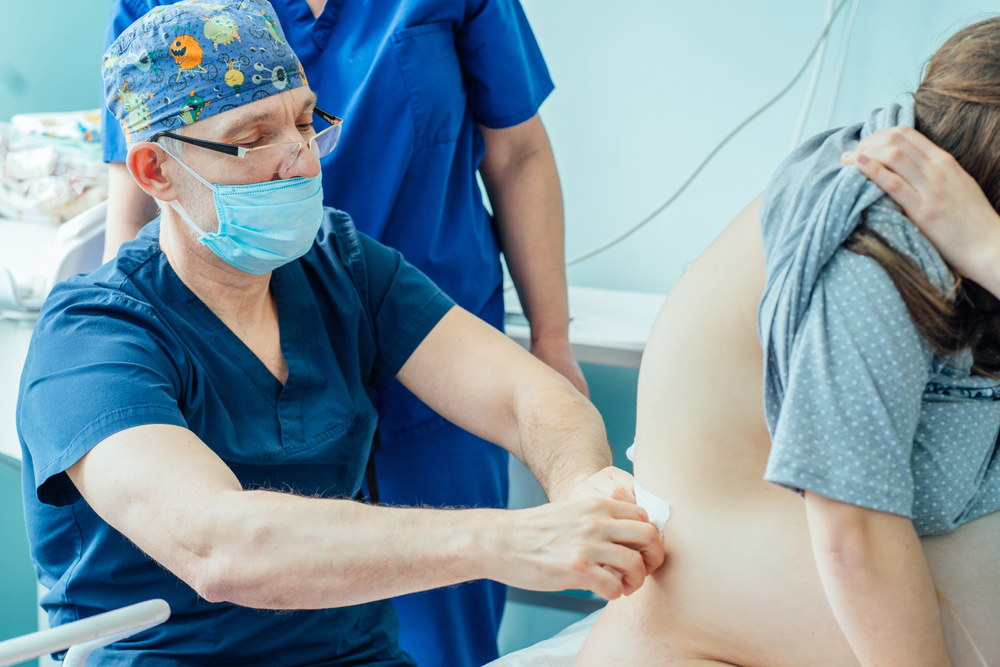
One moment brings a routine epidural placement. The next demands an immediate response to an emergency cesarean section. Yet the procedures that make pain relief possible during these critical moments rely on what Dr. Gallin calls a “blind procedure.” Current epidural placement depends broadly on anatomical landmarks and tactile feedback. Anesthesiologists must navigate by touch alone, feeling for the subtle “loss of resistance” that signals successful needle placement.
This approach comes with risks for mothers. When complications occur, the consequences extend far beyond the delivery room.
The Reality of Modern Obstetric Challenges
The technical demands of epidural placement grow more complex with each patient variation. Dr. Gallin encounters mothers with scoliosis, those with large body habitus, and patients whose previous surgeries have altered their anatomy.
“Placing an epidural is a challenging procedure in and of itself,” she notes. “It becomes even more technically challenging if a patient has scoliosis or a large body habitus.”
But the technical aspects represent only part of the challenge. Patient psychology plays an equally important role. “Many patients come in with a lot of fear around epidurals or neuraxial anesthesia,” Dr. Gallin explains. “Everyone has Googled or has a horror story from a friend.”
These fears aren’t unfounded. When traditional landmark-based techniques encounter difficult anatomy, the results can be frustrating for everyone involved:
- Multiple insertion attempts increase patient discomfort.
- Extended procedure times disrupt workflow.
- Provider stress rises as standard techniques fail.
- Patient anxiety escalates with each unsuccessful attempt.
Dr. Gallin describes the cycle: “When it’s challenging technically, or the patient’s having a very hard time, it can be really frustrating as a provider. You want to do the right thing for your patient and give them the best experience you can.”
Her take? The stakes in obstetric anesthesia demand better solutions.
The Hidden Long-Term Impact
Post-dural puncture headaches (PDPH) represent one of obstetric anesthesia’s most serious complications. For some patients, these aren’t temporary discomforts that resolve within days; they’re a lasting reminder of a preventable complication.
“A patient will present with an excruciating positional headache within 24 to 48 hours after an inadvertent dural puncture,” Dr. Gallin explains. The immediate impact is severe — mothers unable to sit upright, struggling to participate in breastfeeding and newborn care.
But recent research reveals a more troubling reality.
“Data has been coming out that these patients — they’ve been tracking patients for about 18 months after an inadvertent dural puncture — about 30% of them will go on to have chronic headaches,” Dr. Gallin notes.
Nearly one in three mothers who experience accidental dural punctures face ongoing pain that can persist for months. This statistic sounds alarm bells about how anesthesiology providers must view these complications. What seems like short-term procedural difficulties can carry the potential for long-term suffering. New mothers deserve better outcomes.
“We take this adverse event extraordinarily seriously because not only is it causing discomfort for a patient in the short term, but we don’t want to cause any long-term complications,” Dr. Gallin emphasizes.
Technology as the Natural Evolution
In the pursuit of reducing PDPH and other complications, Dr. Gallin envisions a different approach to delivering obstetric neuraxial anesthesia. Instead of relying on tactile feedback alone, ultrasound image guidance could provide what she calls “essentially X-ray vision.”
“Right now, it’s a blind procedure. It’s focused on landmarks and physical touch and feedback,” she explains. “Technology like RIVANNA’s Accuro 3S guidance system is incredibly exciting for an anesthesiologist.”
Current techniques demand intense concentration. Anesthesiologists must simultaneously:
- Focus on precise needle placement
- Monitor patient vital signs
- Manage patient comfort and anxiety
- Prepare for potential complications
“Having a guidance system that would decrease the cognitive load would make this whole process much easier,” Dr. Gallin notes. AI-assisted imaging allows providers to “know exactly where you are” during the procedure.
Patient acceptance of this technology comes naturally, too. “I think the patients are excited about technology,” Dr. Gallin observes. “They’re very comfortable with ultrasound; they just received ultrasounds for nine months throughout their pregnancy.”
The familiarity breeds confidence rather than concern.
“Being able to tell a patient that I have a new image guidance system and potentially a way to decrease error rates is something that they would be very excited about, and would give them a lot of confidence.”
Clinician-Centered Innovation
Dr. Gallin’s enthusiasm for RIVANNA’s Accuro 3S system extends beyond its clinical capabilities. The company’s development approach impressed her as much as the technology itself.
“I really enjoyed working with RIVANNA, because they have included clinicians from the very beginning, in terms of their design — the interface,” she explains. This collaborative method creates devices that actually serve their intended users. “What I really appreciate about them is that they’re always asking me and other colleagues, ‘What do you want to see? How do you actually use this?’”
The contrast with typical medical device development is stark. “Oftentimes, when you have a device or a new technology, it’s created by engineers who are wonderful, but they’re not the end user.” By involving practicing anesthesiologists from early design stages, RIVANNA created something genuinely user-friendly.
The result is technology designed by clinicians, for clinicians.
Making Precision Standard Practice
The case for adopting image guidance in obstetric neuraxial anesthesia isn’t theoretical. It’s practical, immediate, and patient-focused.
“At the end of the day, if there’s anything that can help me be a better physician, take care of patients better, decrease my adverse events — I’m excited to embrace it,” Dr. Gallin states. Traditional techniques will always have their place. “You could do it without it, and we have for many years,” she acknowledges. But when better options exist, the choice becomes clear.
“Now that there’s an option that could take away all the guesswork, why wouldn’t I use it?”
The mothers facing chronic headaches from procedural complications deserve this consideration. The families disrupted by extended recoveries deserve better outcomes. The anesthesiology providers managing complex cases with limited information deserve tools that match their skills and dedication.
Precision guidance represents the natural evolution of neuraxial anesthesia. Dr. Gallin’s experience demonstrates that this evolution can’t come soon enough.
The views expressed are solely my own and do not represent the views of the hospital.