

Featuring Dr. Steve Garber, Obstetric Anesthesiologist, Saddleback Hospital
In the delivery suite, precision is personal. Every placement, every decision, can shape a mother’s experience of birth. For Dr. Steve Garber, an obstetric anesthesiologist with more than three decades of practice at Saddleback Hospital, that awareness guides every moment of care.
Over the years, Dr. Garber has seen technology advance, but rarely in ways that changed the feel of the work itself. Then came RIVANNA’s Accuro 3S.
He had been among the first to integrate the original Accuro into his workflow, using its ultrasound-based guidance to visualize spinal landmarks. But the Accuro 3S, he says, is something entirely new: a tool that merges AI-enhanced imaging with live needle tracking, giving anesthesiologists a real-time window into the procedure.
“We’re going to be safer, more efficient, and more precise,” Dr. Garber reflects. “It’s an exciting time to be an obstetric anesthesiologist.”
From Palpation to Precision
For generations, epidural placement has depended on palpation, the process of locating the spine through touch and experience. That technique remains a craft, but even skilled hands face uncertainty in patients with high BMI, scoliosis, or prior spinal instrumentation.
When Dr. Garber first adopted the original Accuro, he found that its ultrasound guidance didn’t replace skill — it enhanced it. The handheld device translated what had been tactile into something visible, measurable, and teachable. “It let me see what I used to feel,” he says.
This visibility became routine on his unit. “At least once or twice a shift, I’d reach for the Accuro,” he adds. “It became part of how we work.”
Yet he imagined the next step: What if we could follow the needle’s path as it advanced?
The Leap to Live Needle Tracking
That question became the foundation for Accuro 3S. Through direct collaboration with RIVANNA’s engineering team, Dr. Garber’s feedback helped shape early prototypes designed for labor and delivery.
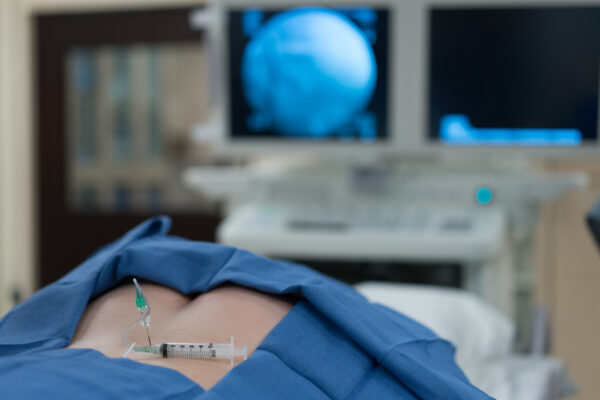
The result is a system that feels both intuitive and transformative. A custom patient drape has bands that support the probe to allow both hands for needle access, generating a steady ultrasound image. The screen renders the spinous processes, epidural space, and ligamentum flavum in high definition and includes live needle tracking, allowing clinicians to watch the instrument move in real time.
“It’s remarkable,” Dr. Garber says. “You can actually see the needle traverse the tissue planes, and you know — without guessing — that you’re exactly where you need to be.”
For his team, this clarity changed more than workflow; it changed patient interaction. Laboring mothers, once anxious about the unknown, now may see calm, deliberate confidence in their physician’s movements. “When patients sense that,” he notes, “their whole experience changes.”
AI That Serves the Practitioner
Artificial intelligence is often discussed in sweeping, impersonal terms. Dr. Garber’s view is refreshingly grounded: Technology should serve clinicians, not supplant them.
“Everyone’s talking about AI taking over,” he says. “Here, it’s doing exactly what it should — helping physicians be better.”
With Accuro 3S, AI is providing information, not making decisions. By identifying anatomical structures and marking key depths, it is engineered to guide attention without interrupting judgment. The anesthesiologist remains fully in control — only now with sharper data and fewer unknowns.
For educators, that clarity can be transformative. Resident physicians may watch the needle advance on screen, seeing the anatomy respond in real time. “It’s no longer a ‘feel’ exercise,” Dr. Garber explains. “You’re showing them exactly what’s happening. That’s how confidence is built.”
A Tool for Real-World Challenges
High-BMI patients, scoliosis, and scar tissue present unique hurdles that often make traditional landmark methods unreliable. In those cases, every second counts.
Dr. Garber recalls a recent study period in which Accuro 3S allowed his team to visualize the epidural space instantly, reducing needle redirections and improving efficiency. “It’s not about speed,” he clarifies. “It’s about certainty.”
The ability to see both the target and the trajectory meant fewer surprises — and a smoother, calmer experience for everyone involved. That’s what keeps Dr. Garber energized.
“After decades in this field, it’s rare to encounter something that genuinely changes how you practice,” he says. “This does.”

Encouraging Colleagues to Embrace Change
Adoption is often the hardest part of innovation. Dr. Garber understands why: experienced clinicians know what works and trust their instincts. But he encourages his peers to take a look for themselves.
“You might never have trouble placing an epidural,” he says. “But one day you’ll meet a patient whose anatomy makes it difficult — and you’ll wish you had this in your toolbox.”
This message isn’t about replacing skills and experience. It’s about equipping practitioners for the moments when experience alone isn’t enough.
“We all have those cases,” he adds. “Why not have something that gives you another level of precision?”
Confidence, Clarity, and the Future of Obstetric Anesthesia
Progress in anesthesia rarely arrives with fanfare. It can show up quietly in better visibility, steadier hands, and more confident patients. For obstetric anesthesiologist Dr. Steve Garber, RIVANNA’s Accuro 3S represents that kind of progress: a marriage of clinical expertise and intelligent technology.
The future of obstetric anesthesia may be defined not by replacing human skill, but by amplifying it. In that partnership — between practitioner and innovation — confidence can become the new standard of care.
The views expressed are solely Dr. Garber’s own and do not represent the views of his employer.